
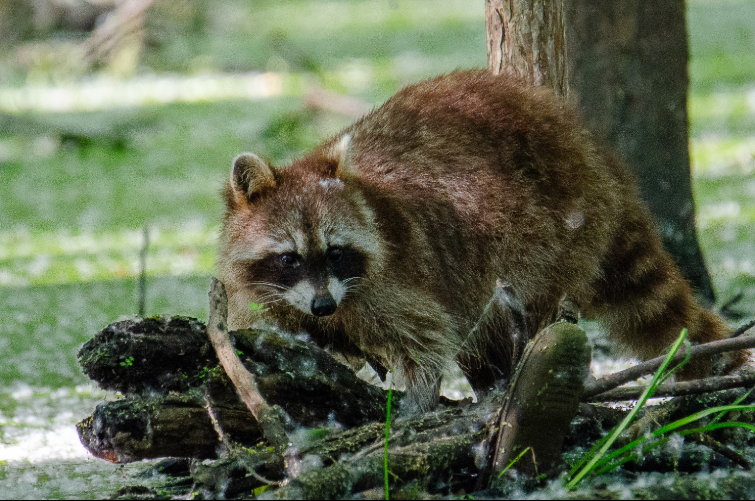
Since December 2024, a total of 159 cases of raccoon rabies have been confirmed in Quebec. The re-emergence of this disease, which began in Estrie, is now spreading toward the south shore of Montreal. No human or domestic animals have been infected to date. Everyone’s vigilance remains essential.
A disease returning after years of absence from Quebec
Until very recently, raccoon rabies seemed to belong to Quebec’s past; the last case had been detected in 2015. Then, in December 2024, the virus resurfaced, and the situation has continued to evolve ever since. This return was not entirely unexpected, as cases had been multiplying in neighbouring Vermont since 2022. Quebec authorities had already intensified their preventive wildlife vaccination operations. Despite these efforts, however, the virus crossed the border, first entering the Saint-Armand area east of Lake Champlain.
A toll that grows week by week
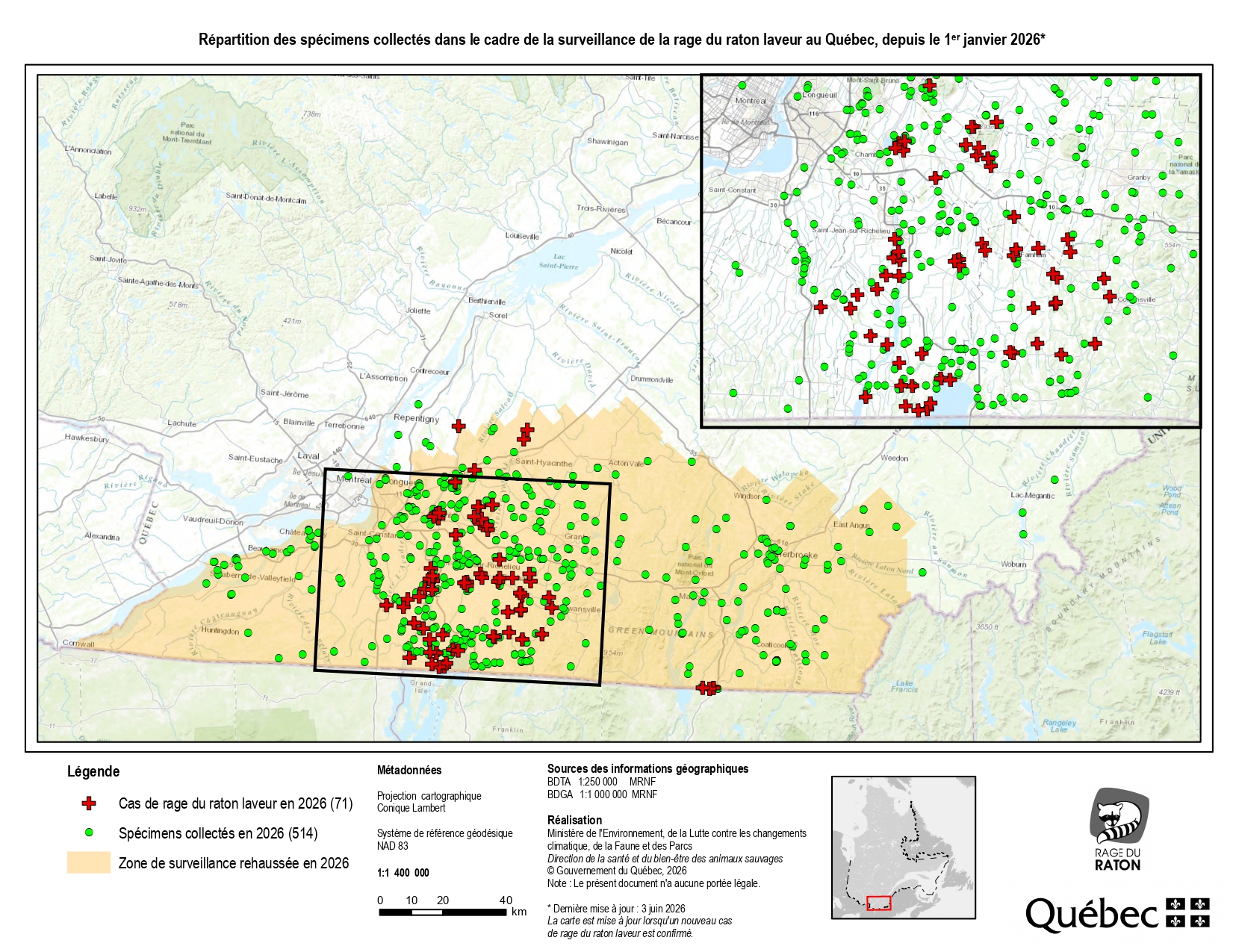
The numbers speak for themselves. From December 2024 to early June 2026, 159 cases of raccoon rabies have been confirmed in wild animals in Quebec. In 2025, 93 cases were recorded, 84 of which were in Estrie. Since January 2026, Monterégie has become the epicentre, with 71 new cases. The main outbreak, which appeared in Saint-Armand in December 2024, has progressed northward, with confirmed cases as far as the Bromont and Mont-Saint-Hilaire areas. A few isolated cases have also been documented west of the Richelieu River (Saint-Jean-sur-Richelieu) and in the Saint-Hyacinthe area (Saint-Barnabé-Sud). A second, smaller outbreak has been developing in the Stanstead area, south of Sherbrooke, since August 2025.
What is raccoon rabies?
Rabies is a viral disease that can attack the central nervous system of mammals. In Quebec, the three main variants are the raccoon variant, the bat variant, and, in northern Quebec, the fox variant. Although all mammal species (including humans) are potentially susceptible to the raccoon variant, this virus is maintained primarily in raccoons and striped skunks. Transmission occurs through bites or contact of an open wound with the saliva of an infected animal. Once clinical signs appear, rabies is fatal in virtually all cases. This is why any potential exposure must be taken seriously and treated without delay. Rabies should be suspected in an animal that is disoriented, shows no fear of humans, displays unusual aggression or, conversely, prostration or progressive paralysis. A raccoon or skunk active in broad daylight in an urban area, or an animal that does not flee, should raise suspicion.
Government measures in place
The Government of Quebec, through the Ministère de l’Environnement, de la Lutte contre les changements climatiques, de la Faune et des Parcs (MELCCFP), has implemented several major interventions. More than 206,000 vaccine baits have been distributed across nearly 2,500 km² in 55 municipalities. Aerial drops complement ground-level distributions. A trap-vaccinate-release program is also under way in 32 municipalities in Monterégie, in which raccoons and skunks are captured, hand-vaccinated against rabies, and returned to the wild. In addition, 160 municipalities in Estrie and Monterégie are subject to a ban on transporting live raccoons, skunks, foxes, and coyotes, a measure designed to prevent well-intentioned citizens from inadvertently spreading the virus.
CWHC – Quebec’s involvement in the rabies surveillance program
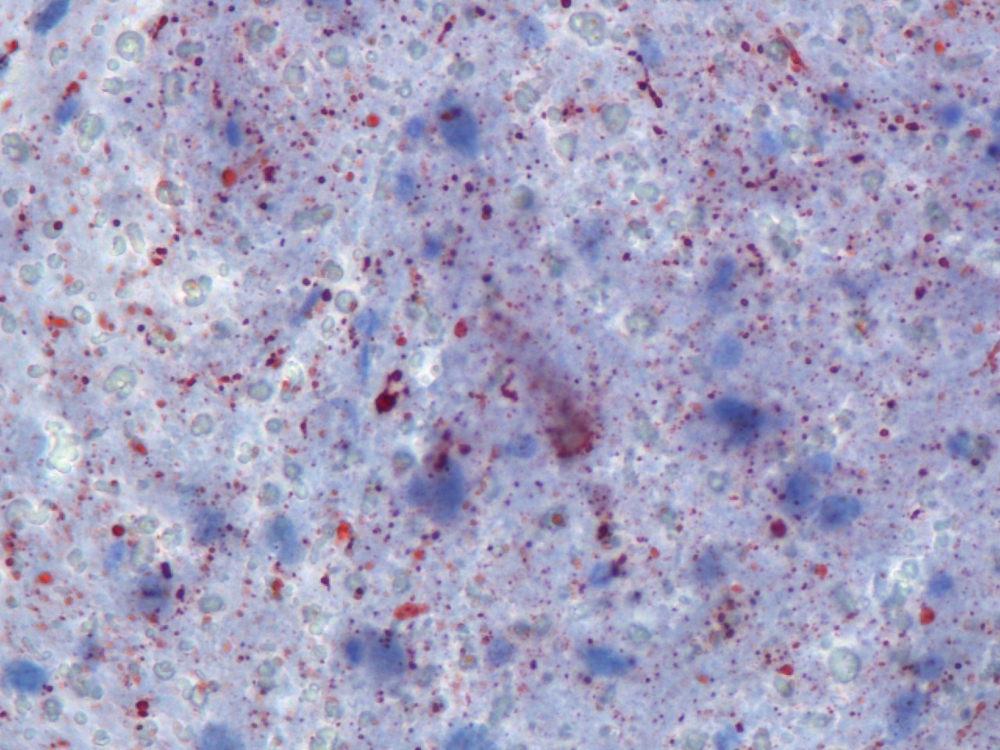
In order to properly develop preventive and control measures, surveillance of this viral condition in wild animals is essential. Through its diagnostic expertise, the CWHC regional centre for Quebec actively participates in raccoon rabies surveillance and control efforts. Raccoons, striped skunks, foxes, and coyotes found dead or sick within the enhanced surveillance zone (Fig. 1) are collected by MELCCFP teams and submitted for analysis to CWHC – Quebec, where a rapid immunoperoxidase detection test is performed on each specimen (Fig. 2). Since 2010, approximately 17,000 tests have been carried out (including approximately 3,000 since the beginning of 2025).
What you should do
In the event of a bite or scratch from an animal, wash the wound thoroughly with soap and water for at least 10 minutes, then call 811 (Info-Santé – for Quebec) for a medical evaluation. Post-exposure preventive treatments are highly effective if administered promptly. Do not delay, even if the injury seems minor. You can also report a suspected animal by calling 1 877 346-6763 (in Quebec).
To protect your pets, ensure that your dog or cat is up to date on rabies vaccination and avoid letting your animal roam unsupervised. Use garbage cans with locking lids. Do not leave pet food outdoors. Remove bird feeders or use raccoon-resistant models. Block access under decks and other shelters. Never move a captured wild animal. Always call the appropriate authorities.
A public health challenge
Raccoon rabies thus appear to be firmly established in southern Quebec, representing a challenge for both animal health and public health. Control and vaccination operations will need to continue in the coming years if eradication from Quebec’s territory is to be achieved. History shows that this is possible: in the early 2000s, a large-scale vaccination campaign successfully eradicated raccoon rabies from Quebec following a first epidemic wave.
Stéphane Lair, CWHC-QUEBEC / CQSAS