
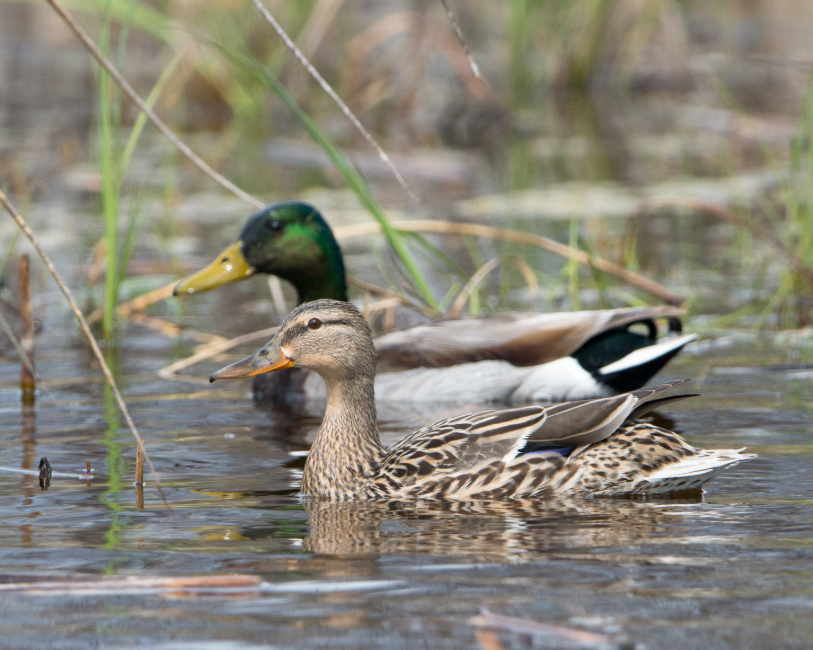
Many wildlife health issues, including avian influenza, also impact humans and other animals. Traditional research approaches are often ineffective at tackling these challenges. Using a One Health approach that considers human, animal and environmental health can help us more effectively address these problems. Though avian influenza is not a new issue, the emergence of new strains of highly pathogenic avian influenza (HPAI) has resulted in major disease outbreaks around the world (Krammer et al., 2025). These outbreaks have affected wild birds, poultry, and wild and domestic mammals, most notably dairy cattle. A small number of cases have even been detected in humans, though there is currently no evidence of human-to-human transmission (Garg et al., 2025). It is becoming increasingly clear that HPAI is a threat to wildlife, domestic animal, and human health – a true One Health problem.
For many years, the CWHC has modelled a collaborative approach to disease surveillance and research. By working with members of the public, private veterinary clinics, wildlife rehabilitation centres, and government agencies for specimen collection, private and government diagnostic laboratories for testing, and provincial and federal agencies for scientific communication, the CWHC has demonstrated how effective such a model can be.
This collaborative, One Health, approach isn’t limited to just the CWHC. For example, in 2024 public health, wildlife health, and agricultural partners across the government, academic, and private sectors launched a joint initiative to examine risk factors for HPAI outbreaks on poultry farms using a new multi-disciplinary approach (Giacinti et al., 2026). The CWHC has contributed to this study by working with Environment and Climate Change Canada (ECCC) to document wildlife presence and behaviour on poultry farms, visiting farms to conduct visual observations and deploy acoustic recording units and trail cameras. This study has already resulted in the development of a stronger, more holistic approach to disease surveillance as well as improved engagement and research communication with private industry (Giacinti et al., 2026).
Wildlife health issues like HPAI require research approaches that address the transdisciplinary nature of such problems. If solutions to issues like HPAI are to be found, it will require collaboration between public health, wildlife health, and domestic animal health experts in government, academia, and private industry. As new wildlife, domestic and human health challenges emerge, the CWHC is committed to continuing to engage with our partners to find ways to more effectively tackle complex One Health problems like HPAI.
Written by: Dan Bayley
References
- Garg, S., Reinhart, K., Couture, A., Kniss, K., Davis, C. T., Kirby, M. K., Murray, E. L., Zhu, S., Kraushaar, V., Wadford, D. A., Drehoff, C., Kohnen, A., Owen, M., Morse, J., Eckel, S., Goswitz, J., Turabelidze, G., Krager, S., Unutzer, A., … Olsen, S. J. (2025). Highly Pathogenic Avian Influenza A(H5N1) Virus Infections in Humans. New England Journal of Medicine, 392(9), 843–854. https://doi.org/10.1056/nejmoa2414610
- Giacinti, J. A., Sharp, C., Crawshaw, L., Kloeze, H., Dam, A., Provencher, J. F., Racicot, M., Bayley, D., Berhane, Y., Blais-Savoie, J., Boutin, A. C., Bowman, J., Conner, W., Cox, T., Delatolla, R., Fitzgerald, S., McClinchey, H., Mubareka, S., Nituch, L., … Jardine, C. M. (2026). One Health, Many Realities: Navigating Collaboration for Avian Influenza Surveillance and Response. One Health Cases. https://doi.org/10.1079/onehealthcases.2026.0003
- Krammer, F., Hermann, E., & Rasmussen, A. L. (2025). Highly pathogenic avian influenza H5N1: history, current situation, and outlook. Journal of Virology, 99(4). https://doi.org/10.1128/jvi.02209-24
- Oljans, E., & Mickelsson, M. (2025). Navigating complexity: teaching sustainability through wicked problems in higher education. Environmental Education Research, 31(8), 1586–1600. https://doi.org/10.1080/13504622.2025.2468821