
How long does it take a fungus to travel 3,210 km on the back of a bat? For the fungus that causes White-nose Syndrome (WNS) the journey from Albany, New York, to Fort Smith, Northwest Territories1 took exactly two decades. That works out to be an average rate of 160.5 km per year or about 18 m per hour. To put that in perspective, that’s about the pace of a crown-of-thorns starfish crawling across a coral reef.2 While the fungus spreads relatively slowly, the impact on bats is rapid. Since the arrival of this fungus in North America, WNS has caused devastating declines in bat populations.
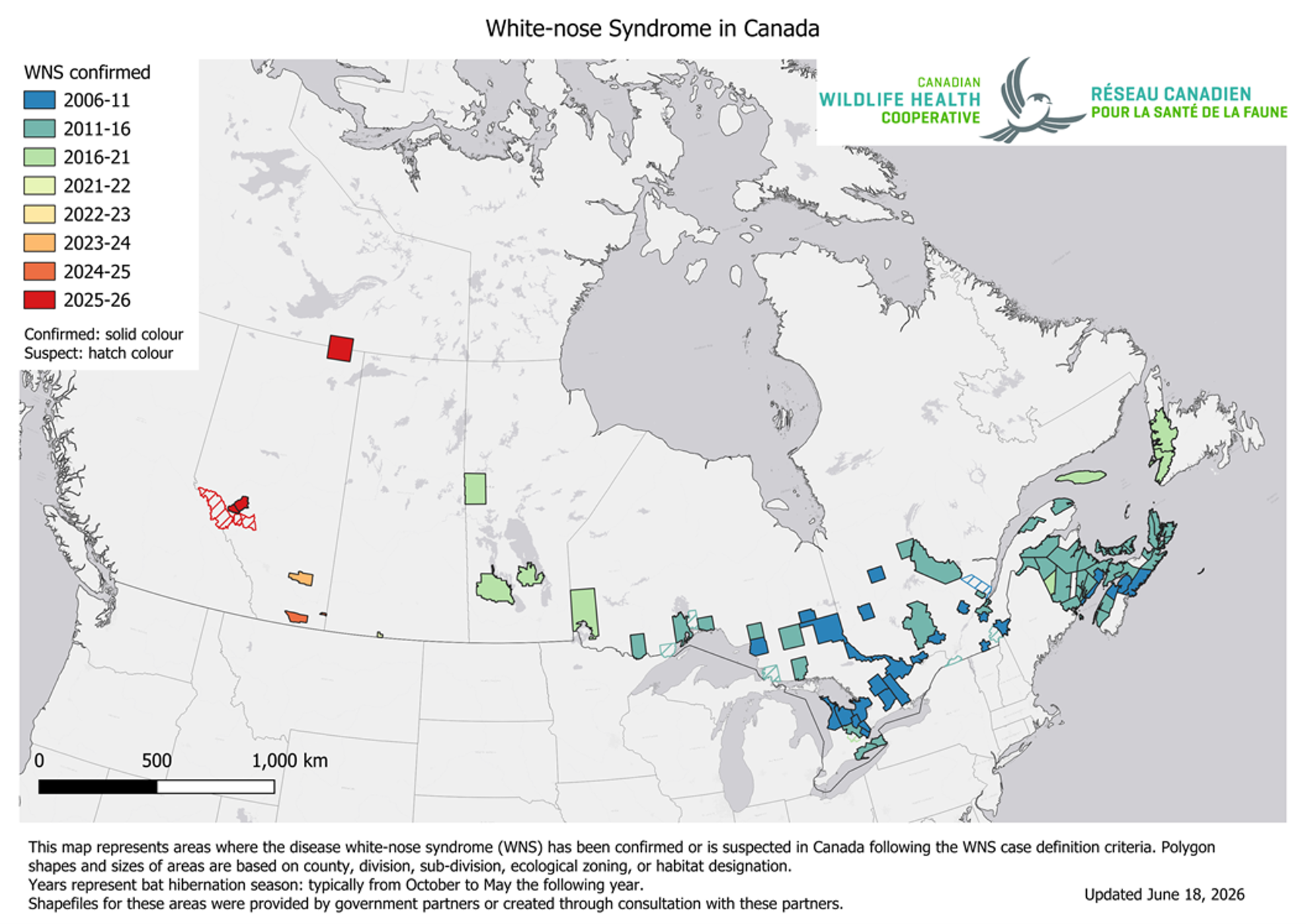 The Canadian Wildlife Health Cooperative has monitored the spread of this bat-killing fungus across Canada. In addition to its recent detection in the Northwest Territories, new westerly records have been reported near the border between Alberta and British Columbia marking the continued expansion of the disease.
Recently, the Western and Northern Regional Centre received a northern long-eared bat submitted by the Government of the Northwest Territories. The bat was found dead in a cave in early May and displayed the classic visible and microscopic lesions associated with WNS. Laboratory testing confirmed infection with the WNS fungus.
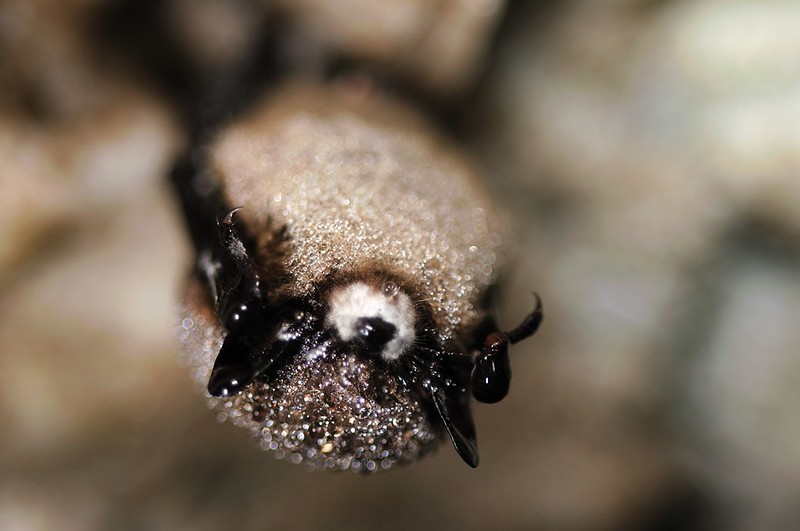
The fungus itself has a surprisingly complicated name that sounds more like a What3words location than a pathogen. The Latin name Pseudo-gymno-ascus destructans roughly translates to “false-naked-sac destroyer.”3 In contrast, the disease it causes has a simplistic and descriptive name: White-Nose Syndrome. The name originates from the characteristic white fungal growth that is particularly noticeable around the nose. The skin around the nose contains multiple large glands that produce material rich in fats which this fungus thrives on.4
Since WNS was first discovered in North America, it is estimated to have killed more than six million bats. But during this time there has also been the development of new treatments like vaccines and probiotics that can reduce the impact of this infection.5,6 As these advances continue to be tested and refined hopefully, they will translate into improved management of this disease for bats of the Northwest Territories.
Written by: Ursula Perdrizet
Edited by: Trent Bollinger, Joanna Wilson
References
- Government of the Northwest Territories. 2026. “White-Nose Syndrome and the Fungus That Causes White-Nose Syndrome in Bats Found in the Northwest Territories– What You Need to Know.” https://www.gov.nt.ca/en/newsroom/white-nose-syndrome-and-fungus-causes-white-nose-syndrome-bats-found-northwest-territories
- Great Barrier Reef Foundation. Crown-of-thorns starfish [Internet]. 2026. https://www.barrierreef.org/the-reef/threats/Crown-of-thorns-starfish
- GBA Group. 2026. “Mold Pseudogymnoascus pannorum.” January 7, 2026. https://www.gba-group.com/en/blog/environment/mold-pseudogymnoascus-pannorum/
- Meteyer CU, Dutheil JY, Keel MK, Boyles JG, Stukenbrock EH. 2022. Plant pathogens provide clues to the potential origin of bat white-nose syndrome Pseudogymnoascus destructans. Virulence 13:1020–1031. https://www.tandfonline.com/doi/full/10.1080/21505594.2022.2082139#abstract
- Rocke, T.E., Kingstad-Bakke, B., Wüthrich, M. et al. 2019. Virally-vectored vaccine candidates against white-nose syndrome induce anti-fungal immune response in little brown bats (Myotis lucifugus). Sci Rep9, 6788 https://doi.org/10.1038/s41598-019-43210-w
- Insuk, C., A. Forsythe, N. Fontaine, et al. 2025. Probiotic Prophylaxis for White-Nose Syndrome: Testing Use of a Probiotic to Reduce Bat Mortality Caused by White-Nose Syndrome. Synthesis Report. Published by Thompson Rivers University, McMaster University, and Wildlife Conservation Society, Canada, Toronto, ON. 1-25. https://doi.org/10.19121/2025.Report.52408.