
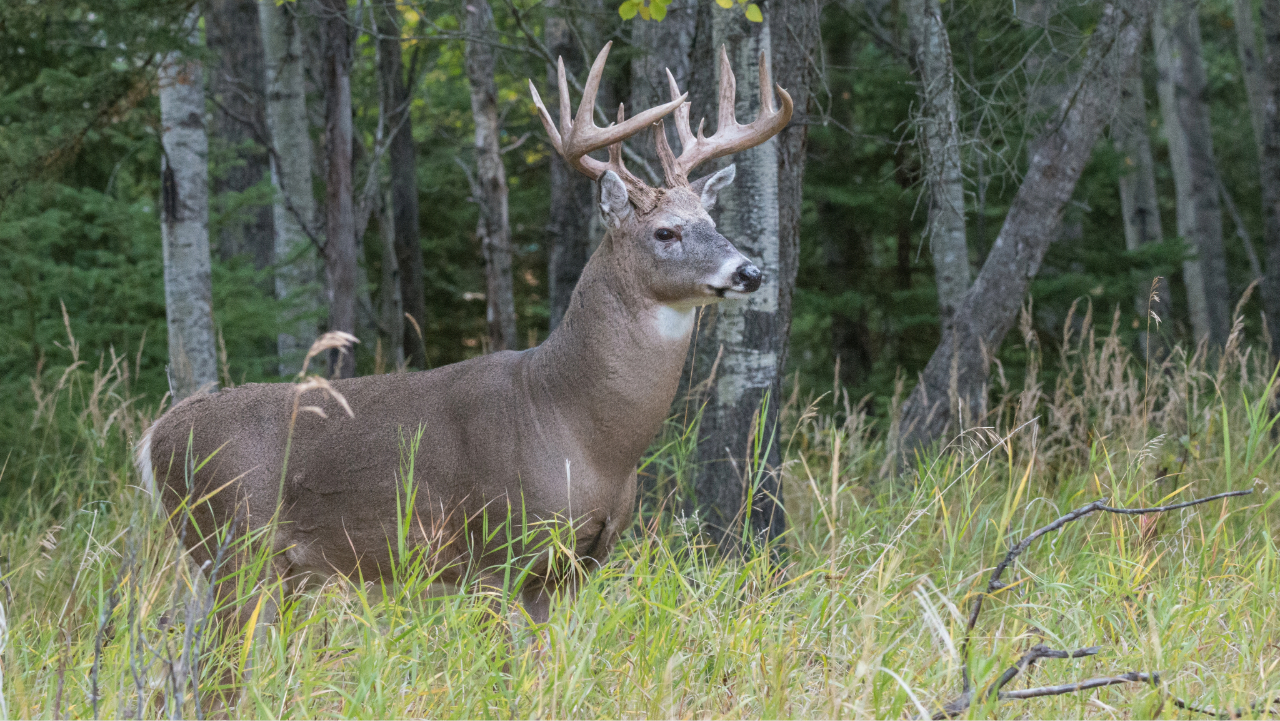
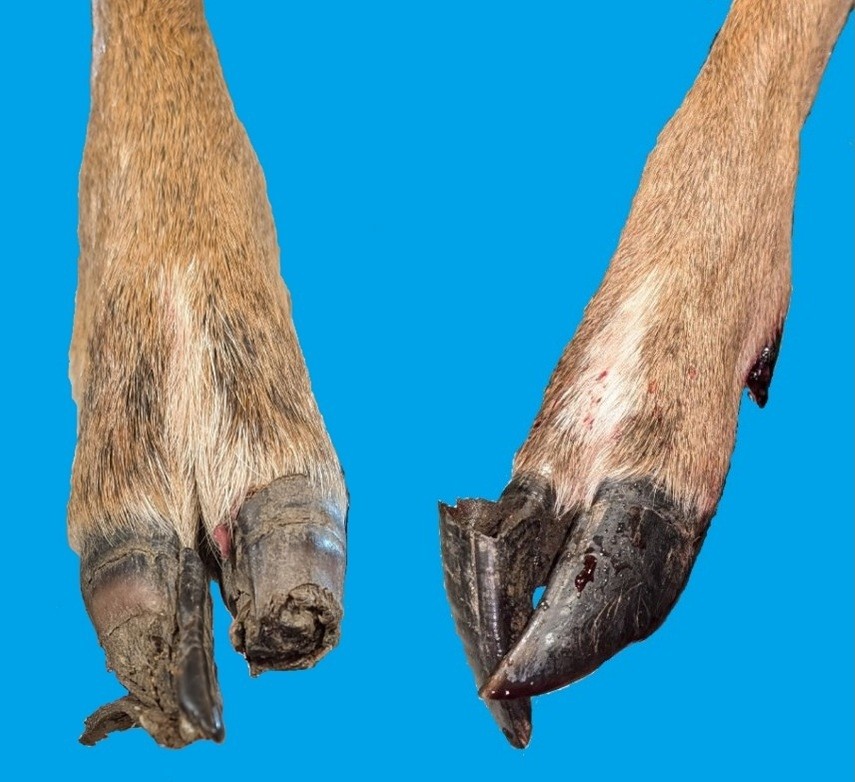
Every fall in Ontario, thousands of hunters head into the woods in pursuit of white-tailed deer. For many, hunting is a way to source meat and connect with nature, but it also presents an important opportunity to assist with the monitoring of wildlife health. In early November this year, a hunter near Fort Erie, Ontario harvested a deer showing unusual symptoms. Lesions on the hooves and abscesses near the tarsal glands raised concern, prompting the hunter to contact the Canadian Wildlife Health Cooperative (CWHC). Post-mortem testing confirmed the deer was positive for Epizootic Hemorrhagic Disease – more commonly known as EHD. Though not a concern for human health, EHD can have severe impacts on deer populations. Domestic cattle and sheep can also be affected by this disease, but this is less common 3.
EHD is caused by a virus transmitted by biting midges that primarily affects wild ruminants. In late summer and early fall, warm and moist conditions create ideal environments for midge breeding. This then results in high midge populations which can efficiently spread the virus between deer. Outbreaks typically occur in years with a wet spring followed by a hot, dry summer/fall. Symptoms of EHD typically include lethargy, fever, respiratory distress, salivation, and swelling of the head, neck, and tongue. Deer infected with EHD often die near water. Those that survive the acute infection are often left with chronic symptoms like lameness, poor body condition and hoof deformities, like the recently tested deer from Fort Erie 3. While this disease is more common in the southern United States, climate change appears to be expanding the range of biting midges northward 5. Since deer in the south have been exposed to the virus for longer, southern deer populations have developed higher levels of immunity to the virus compared to their northern neighbors 6. As a result, outbreaks among deer populations in Canada and the northern United States more often result in significant mortality events.
However, it is important to note that EHD is not the only disease affecting white-tailed deer. Several other diseases share similar symptoms, which makes identification in the field difficult. For example, bluetongue is a disease closely related to EHD. It is spread by the same type of midges, occurs in the same season, and presents with nearly identical symptoms in deer. Unlike EHD however, bluetongue typically affects livestock more severely than it does wild deer 1.
Another disease of major concern for deer is Chronic Wasting Disease (CWD). CWD has not been detected in wild deer in Ontario, and the Ontario Ministry of Natural Resources (MNR) continues to conduct active surveillance for this disease. CWD is caused by a misfolded protein that then spreads between animals through bodily fluids and contaminated environments. Symptoms progress slowly and include weight loss, drooling, drooping ears, lack of coordination, and abnormal behavior. CWD does not cause hoof lesions or swelling in the head and tongue like EHD and bluetongue do 2. CWD has caused major population-level declines in deer populations where it has become established 4.
So how can you help? If you come across a sick or dead deer, please contact the Canadian Wildlife Health Cooperative. In Ontario and Nunavut, you can make a report online by clicking here or by calling us at 1-866-673-4781. Hunters who observe unusual symptoms in harvested deer are encouraged to report these as well. Even if your deer appears healthy, you can still contribute to CWD surveillance if you are hunting in a priority surveillance area. To have your harvested deer tested for CWD, please follow the directions provided here by the MNR. Since deer with CWD appear healthy for much of the infectious period, sampling apparently healthy animals is essential for early detection. Ultimately, many diseases affecting deer share similar symptoms, so only diagnostic testing can definitively identify the cause. Public reporting and hunter participation play a key role in wildlife disease surveillance and helps to ensure Ontario’s deer population remains healthy and resilient.
Prepared by Dan Bayley
References
- Barua, S., Rana, E. A., Prodhan, M. A., Akter, S. H., Gogoi-Tiwari, J., Sarker, S., Annandale, H., Eagles, D., Abraham, S., & Uddin, J. M. (2025). The Global Burden of Emerging and Re-Emerging Orbiviruses in Livestock: An Emphasis on Bluetongue Virus and Epizootic Hemorrhagic Disease Virus. In Viruses (Vol. 17, Issue 1). Multidisciplinary Digital Publishing Institute (MDPI). https://doi.org/10.3390/v17010020
- (2024). Chronic Wasting Disease in Animals. https://www.cdc.gov/chronic-wasting/animals/index.html
- Cornell Wildlife Health Lab. (2025). Hemorrhagic Disease of Deer. https://cwhl.vet.cornell.edu/disease/hemorrhagic-disease-deer
- Edmunds, D. R., Kauffman, M. J., Schumaker, B. A., Lindzey, F. G., Cook, W. E., Kreeger, T. J., Grogan, R. G., & Cornish, T. E. (2016). Chronic wasting disease drives population decline of white-tailed deer. PLoS ONE, 11(8). https://doi.org/10.1371/journal.pone.0161127
- Jiménez-Cabello, L., Utrilla-Trigo, S., Lorenzo, G., Ortego, J., & Calvo-Pinilla, E. (2023). Epizootic Hemorrhagic Disease Virus: Current Knowledge and Emerging Perspectives. In Microorganisms (Vol. 11, Issue 5). MDPI. https://doi.org/10.3390/microorganisms11051339
- Kring, E. K., Stallknecht, D. E., D’Angelo, G. J., Kohl, M. T., Bahnson, C., Cleveland, C. A., Salvador, L. C. M., & Ruder, M. G. (2024). Patterns of Hemorrhagic Disease in White-Tailed Deer (Odocoileus virginianus) in the Great Plains of the USA, 1982-2020. Journal of Wildlife Diseases, 60(3), 670–682. https://doi.org/10.7589/JWD-D-23-00021
Your contribution to the CWHC will directly support our efforts to understand wildlife health and disease across the country. Donate here