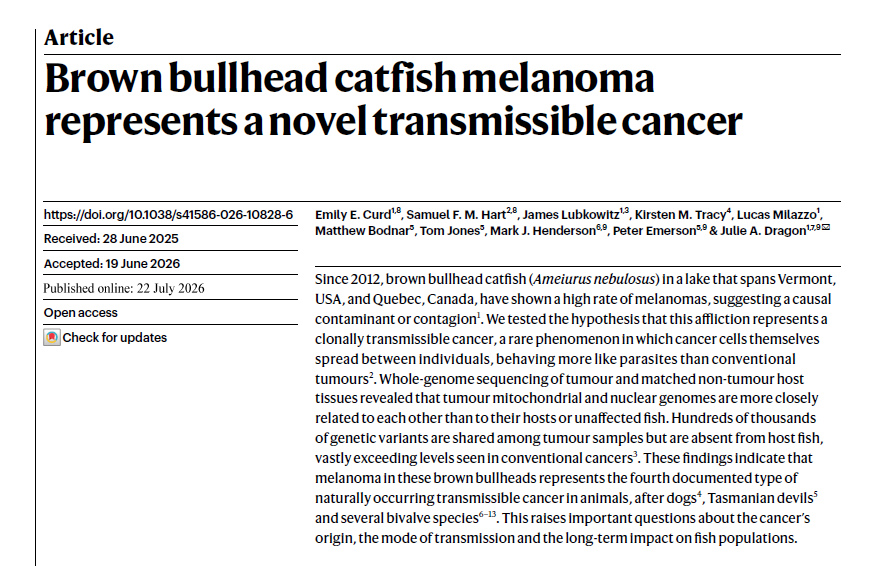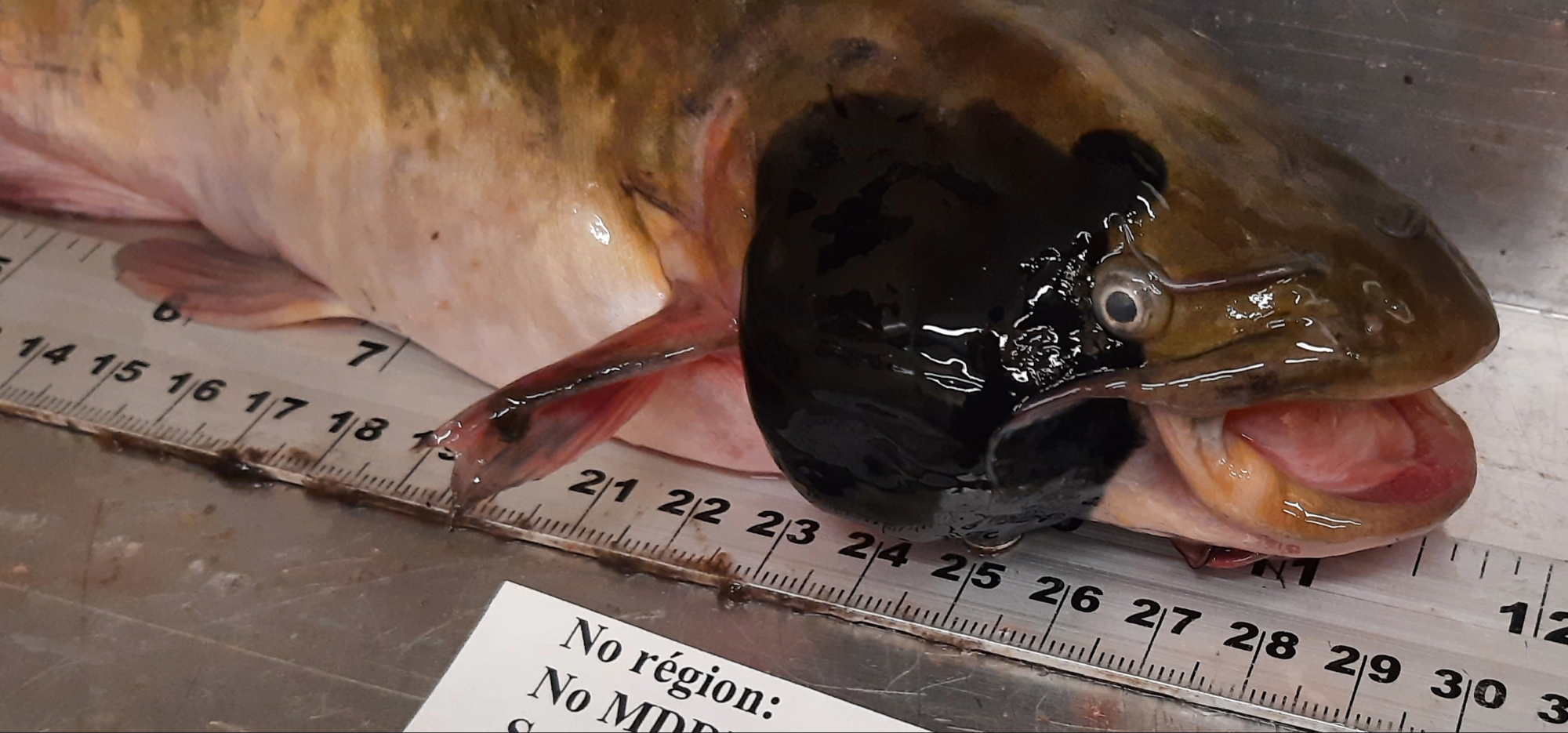
In December 2023, this blog reported the discovery of brown bullheads (Ameiurus nebulosus) presenting with black skin masses. Histological analyses had at the time confirmed that these were melanomas, a potentially malignant tumour of melanocytes. This syndrome has been documented in bullheads since 2012 in Lake Memphremagog and Lake Magog, and various hypotheses have been proposed regarding the causes and risk factors of these melanomas, including exposure to ultraviolet rays or carcinogenic chemical contaminants, or a viral origin.
A research team from the Vermont Biomedical Research Network, in collaboration with the Vermont Fish and Wildlife Department and colleagues from Québec’s Ministère de l’Environnement, de la Lutte contre les changements climatiques, de la Faune et des Parcs, has just published in the journal Nature the results of a large-scale genomic study that instead points to another, rather surprising, hypothesis (Curd EE et al. 2026). According to this study, the melanoma is not caused by a contaminant, a virus, or UV rays, but is instead a transmissible cancer, a cancer that spreads from one fish to another through the direct transfer of the cancer cells themselves, somewhat like a parasite would.
A phenomenon known since 2012, but whose cause remained a mystery
Since 2012, anglers and biologists have reported a growing proportion of brown bullheads in Lake Memphremagog presenting with raised black lesions, particularly around the eyes, along the flanks, and in the oral cavity. A 2020 study had already reported the presence of these lesions in 23 to 37% of bullheads sampled between 2014 and 2017, a prevalence notably higher than that observed elsewhere for this species.
Since the brown bullhead is considered an indicator species for water quality, and Lake Memphremagog serves as a source of drinking water for more than 175,000 people, this high prevalence quickly raised concern and prompted several lines of investigation: contamination linked to flooding, exposure to UV rays, and the presence of a virus or chemical contaminants. None of these hypotheses, however, could be definitively confirmed.
Genome sequencing reveals an unexpected signature
To settle the question, the research team sequenced the mitochondrial and nuclear DNA of tumour tissue and matched healthy tissue from dozens of bullheads in Lake Memphremagog, as well as from unaffected reference fish. Normally, when several individuals develop cancer independently, each tumour carries its own set of genetic mutations specific to that individual. This is what is observed in humans: among 463 human melanomas analyzed for comparison, 94% of genetic variants were unique to a single patient, and only 0.008% were shared by 10 or more cancers.
In the Lake Memphremagog bullheads, the picture is completely different. The researchers found that tumour DNA from different fish resembled each other more closely than it resembled the DNA of the host on which each tumour had grown. In other words, the cancer cells of distinct fish, caught at different locations in the lake and in different years, form a single clonal lineage, descendants of a single tumour that arose once in a “founder” fish and then spread from one individual to another. The tumours form a distinct genetic cluster, clearly separated from the healthy tissue of the fish carrying them. Moreover, the team detected no virus or micro-organism specifically associated with the tumour tissue, despite exhaustive screening. All evidence points to the transmissible agent being neither a virus nor a bacterium, but the cancer cell itself.
The fourth known transmissible cancer in animals, and the first in a fish
Natural transmissible cancers are extremely rare. Before this discovery, only three cases had been documented in animals:
- Canine transmissible venereal tumour, a cancer lineage thousands of years old that spreads through sexual contact and generally regresses on its own;
- Tasmanian devil facial tumour disease, which emerged a few decades ago, spreads through biting, and has caused a marked decline in wild populations;
- Transmissible neoplasia in bivalves, a form of leukemia that has spread independently in at least ten species of bivalve molluscs (mussels, clams, cockles) through transmission in seawater.
The melanoma of brown bullheads in Lake Memphremagog thus becomes the fourth confirmed example of transmissible cancer in the animal kingdom, and the very first documented in a fish.
How does this cancer spread?
The exact mode of transmission remains unknown, but the researchers propose several possibilities based on the biology of the brown bullhead and the mechanisms known from other transmissible cancers:
- Spawning behaviour: bullheads gather in large numbers in shallow areas during spawning, which multiplies the direct physical contacts favourable to cell transfer;
- Lack of scales: the brown bullhead, a bottom-dwelling fish with bare skin, is in close and constant contact with bottom sediments, where cancer cells could potentially persist and be transmitted through the gills, skin, or oral cavity;
- Hormonal changes linked to reproduction, which could temporarily weaken the fish’s immune system at the very time when physical contact is most frequent.
Notably, the melanoma has never been observed in bullheads younger than reproductive age, which supports the hypothesis of a link between reproduction (or aging) and the transmission or expression of the disease.
A risk to the population and to human health?
According to the authors, there is currently no indication that this cancer could affect other fish species in the lake, nor that it poses a risk to human health. Many affected fish also appear to remain in relatively good condition, although in the most advanced cases, tumour cells can invade subcutaneous tissue, muscle, and bone structures, and can even metastasize to other organs.
The long-term impact of this cancer on bullhead population dynamics nevertheless remains an open and priority question. Known precedents point in very different directions: while Tasmanian devil facial tumour disease has proven almost invariably fatal, contributing to a 90% decline in the wild population, canine venereal tumour generally regresses on its own, and bivalve populations persist despite a high prevalence of their transmissible cancer, aside from occasional localized mortality events.
Remaining questions, and a phenomenon that may be more widespread than thought
Researchers still do not know where or when this cancer lineage first arose, nor how long it has been circulating within the bullhead population. More precise molecular dating, along with expanded sampling to other bodies of water, would help clarify the extent of its spread and its true age.
This discovery also raises a broader question: could other fish species presenting with melanistic lesions also be affected by a transmissible cancer? Similar lesions have already been reported in swordtail hybrids, in coral trout, and in smallmouth bass, notably the “blotchy bass syndrome” mentioned in our original blog, which could justify similar clonality analyses in these species.
In short, this study confirms that transmissible cancers, long considered an exceedingly rare biological curiosity, may be more widespread and ecologically significant than previously believed. Continued monitoring of this emerging disease in the brown bullhead of Lake Memphremagog will help improve our understanding of its origin, mode of transmission, and long-term consequences for this fish population.
Written by: Stéphane Lair, CWHC – Québec
References
Curd EE, Hart SFM, Lubkowitz J, Tracy KM, Milazzo L, Bodnar M, Jones T, Henderson MJ, Emerson P, Dragon JA. Brown bullhead catfish melanoma represents a novel transmissible cancer. Nature. 2026. https://www.nature.com/articles/s41586-026-10828-6
Note: this post is an update of the article “Melanomas in Brown Bullheads of Lake Magog, Québec,” originally published on Healthy Wildlife on December 28, 2023 (Olivier Skelling and Stéphane Lair, CWHC-Québec), in light of the results published in 2026 in Nature.